Nylon vs Aluminum Chair Base Strength: A BIFMA Testing Guide for Manufacturers
When engineering a new line of commercial seating, selecting the right base material isn’t just a matter of aesthetics or cost—it dictates the load rating, the warranty lifespan, and the safety of the entire chair.
Procurement managers and R&D engineers constantly debate the merits of different materials. If you are comparing nylon vs aluminum chair base strength and wondering how they stack up against strict BIFMA standards, this guide will help you match the exact right component to your target market.
1. How Does BIFMA X5.1 Test Chair Base Strength?
Before comparing materials, we must understand the benchmark. In North American, European, and high-end South American markets, BIFMA X5.1 is the gold standard for commercial seating.
To pass the BIFMA base test, both nylon and aluminum bases must endure rigorous physical punishment:
- Static Load Test: A massive 2,500 lbs (approx. 1,134 kg) of downward pressure is applied to the center of the base for one minute. The base must not crack, severely deform, or fail.
- Dynamic Drop Test: A heavy weight is repeatedly dropped onto the seat to simulate a large user forcefully sitting down. This tests the fatigue resistance of the base’s internal ribs.
Both high-quality nylon and aluminum bases can pass these tests, but their long-term performance in extreme conditions differs significantly.
2. Nylon Chair Bases: The Commercial Task Seating Standard
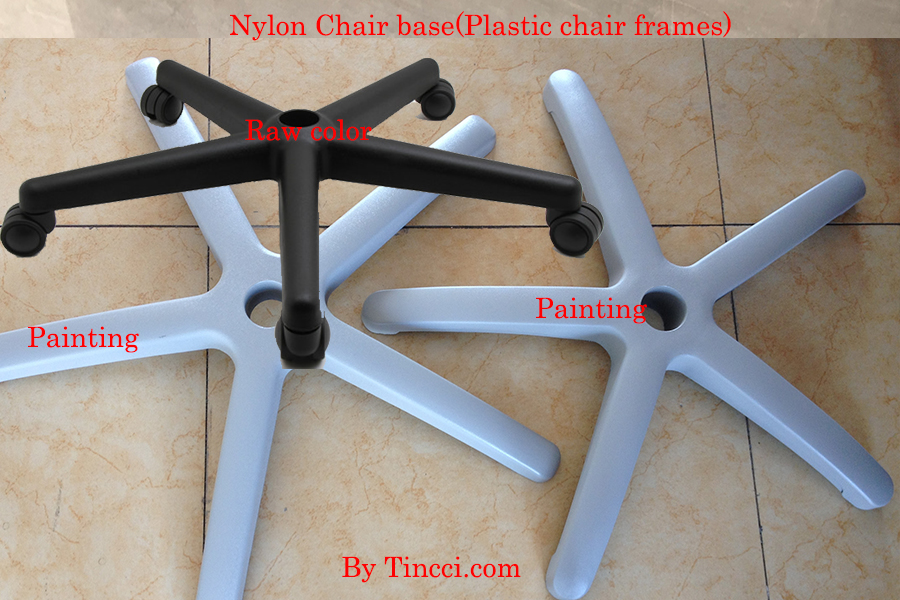
There is a common misconception that “nylon” simply means cheap plastic. In reality, commercial-grade nylon bases are highly engineered composites.
At Tincci, our nylon bases are manufactured using PA66 nylon injected with 30% glass fiber (GF). This glass reinforcement creates a structural web inside the base, drastically increasing its tensile strength.
The Pros:
- Cost-Effective: Injection molding allows for high-volume production, making nylon bases the most economical choice for standard office seating.
- Lightweight: Reduces overall shipping costs and makes the chair easier to maneuver.
- BIFMA Compliant: When molded correctly with fiberglass, they comfortably pass standard BIFMA 2,500 lbs static load tests.
The Limitations: While excellent for standard task chairs and home office seating, nylon has its limits. Under extreme, continuous heavy-duty use (users over 300 lbs), or in environments with harsh temperature fluctuations, the center bore can slowly stretch over the years, causing the gas cylinder to sink.
3. Aluminum Bases: The Heavy-Duty & Premium Standard
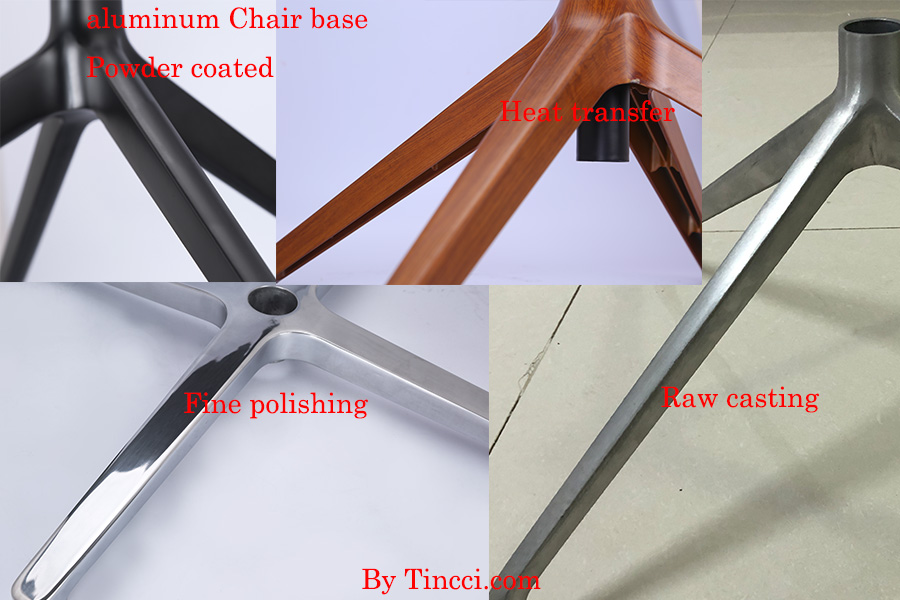
When you are designing executive seating, 24/7 dispatch chairs, or high-end conference room chairs, die-cast aluminum is the undisputed king of strength and aesthetics.
However, not all aluminum is created equal. Low-cost suppliers often use recycled scrap aluminum loaded with impurities, which causes hidden micro-cracks. Premium bases demand 100% virgin ADC12 die-cast aluminum.
The Pros:
- Absolute Structural Integrity: ADC12 aluminum bases offer unmatched crush resistance and fatigue life, easily exceeding standard BIFMA requirements for heavy-duty applications.
- Premium Aesthetics: Aluminum can be highly polished to a mirror finish, brushed, or smoothly powder-coated, delivering the high-ticket look required by A&D (Architecture and Design) firms.
- Zero Deformation: Unlike plastics, the center bore of an aluminum base will never stretch or warp under heavy cyclic loading.
4. The Hidden Trap: Center Bore & Taper Tolerances
Regardless of whether you choose nylon or aluminum, the strength of the base is irrelevant if the center bore taper does not match your gas cylinder.
The connection between the gas lift and the chair base relies on a precise Morse taper friction fit. If the base’s hole is manufactured with poor tolerances:
- In Nylon Bases: An oversized cylinder will act like a wedge, eventually splitting the plastic hub open.
- In Aluminum Bases: A loose fit will cause the gas cylinder to drop too low, scraping the floor and ruining carpets.
This is why experienced manufacturers never buy bases and cylinders from unverified, separate sources without strict tolerance matching.
Need Help Choosing the Right Base for Your Next Chair?
There is no single “best” material—only the right material for your specific chair’s load requirements and market positioning.
Whether you are designing a cost-effective mesh task chair requiring our fiberglass-reinforced nylon bases, or engineering a heavy-duty boardroom seat with our polished ADC12 aluminum 4-star and 5-star bases, Tincci has the BIFMA-tested solutions you need.
As your integrated supply chain partner, our engineering team ensures flawless taper matching between your cylinders and bases before any bulk order is shipped.
📧 Send your chair’s target load requirements and design blueprints to [supplier@tincci.com]. We will recommend the optimal material and send a Mixed Sample Kit (Nylon & Aluminum) for your R&D team to test on your assembly line today.