Swivel Base Seat Mechanism Buying Guide: A Sourcing Manual for Chair Manufacturers
Sourcing hardware for commercial seating looks deceptively simple on paper. However, procurement managers and engineering teams know the reality: a single millimeter of misalignment between a mechanism and a base can bring an entire assembly line to a grinding halt.
If you are sourcing components for executive, task, or hospitality seating, this swivel base seat mechanism buying guide is designed to help you navigate structural specifications, eliminate hidden factory costs, and select hardware built to last.
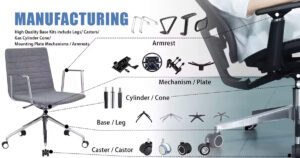
Part 1: The “Kit” Integration Strategy (Why Isolated Sourcing Costs You More)
When sourcing a 360 degree swivel chair base and seat mechanism, many manufacturers make the mistake of splitting orders between different specialized suppliers to chase the lowest piece-part price.
While this might look good on a initial purchase order, it frequently triggers costly issues during mass production:
- Mounting Hole Pattern Mismatches: A standard mechanism pattern (e.g., $150 \times 200\text{ mm}$ or $150 \times 250\text{ mm}$) requires zero-tolerance precision. If your mechanism plate and seat board feature even a $1.5\text{ mm}$ variance, workers on the line will be forced to manually shim or force-fit components.
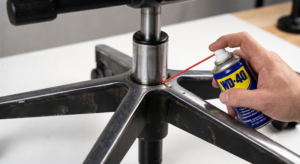
- Taper & Center Bore Friction: The Morse taper junction where the gas cylinder enters the swivel base’s center bore must be perfectly calibrated. A loose fit causes floor scraping under dynamic loads, while an over-tight fit leads to premature structural stress fractures.
The Sourcing Solution: Treat seating hardware as an integrated system rather than isolated parts. Sourcing pre-tested, tolerance-matched base-and-mechanism kits eliminates line-side rework, reduces supply chain complexity, and guarantees smooth assembly out of the box.
Part 2: Material Specifications & Engineering Standards
To command premium pricing in markets across Europe, South America, and North America, your seating line must be backed by heavy-duty engineering. When auditing supplier specifications for mechanisms and bases, focus on three critical material benchmarks:
1. Heavy-Duty Steel Plate Thickness
Cheap mechanisms rely on $1.8\text{ mm}$ to $2.0\text{ mm}$ stamped steel plates, which buckle or squeak under dynamic cyclic stress. Commercial-grade mechanisms require $2.5\text{ mm}$ to $3.0\text{ mm}$ cold-rolled steel plates with reinforced ribbing to maintain structural rigidity under continuous tilt loads.
2. Virgin ADC12 Aluminum vs. Recycled Alloys
For a metal 360 degree swivel chair base, visual inspection isn’t enough. Low-cost factories often use recycled scrap aluminum loaded with silicon impurities, creating internal micro-porosity. Demand 100% virgin ADC12 grade die-cast aluminum, which delivers superior tensile strength and handles high-impact drop tests without fracturing.
3. BIFMA X5.1 & SGS Testing Protocols
Never rely on visual promises. Ensure all base and mechanism assemblies are engineered to pass BIFMA X5.1 dynamic drop tests, proof-load stress tests, and minimum 200-hour salt spray tests for corrosion resistance in high-humidity environments.
2026 Industry Trend Spotlight: The Auto Return Swivel Mechanism
As office spaces and high-end conference rooms pivot toward minimalist, self-organizing aesthetics, static seating hardware is rapidly being replaced.
The dominant design trend in 2026 is the auto return swivel mechanism.
Unlike standard free-spinning mechanisms, an auto return swivel mechanism allows users a full $360^\circ$ smooth rotation during meetings, but automatically and quietly rotates the chair back to its original aligned position once the user stands up. This ensures your clients’ conference rooms always maintain a pristine, uniform appearance without manual realignment.
💡 Exclusive Sample Availability: To help chair manufacturers stay ahead of 2026 seating trends, we offer physical samples of our latest Auto Return Swivel Mechanisms for your engineering team to test.
Stop Guessing on Tolerances. Let Us Review Your Blueprints.
Buying swivel bases and seat mechanisms shouldn’t be a gamble. Before placing your next bulk order, let our team verify physical component compatibility.
As a specialized B2B supply chain partner, Tincci provides a Free Technical Blueprint & Tolerance Review for commercial furniture manufacturers.
What our engineering team will verify:
- Mounting Pattern Alignment: Ensuring mechanism holes match your seat board blueprints.
- Taper Fitment Check: Confirming center bore and cylinder tolerances.
- 2026 Trend Upgrades: Evaluating if an auto-return function elevates your product line.
🛑 Don’t risk your brand’s reputation on mismatched hardware.
📧 Send your CAD drawings (.dwg, .dxf) or PDF specs to [supplier@tincci.com], or request your Auto Return Swivel Mechanism sample today. Our technical team will return a comprehensive review within 24 hours.