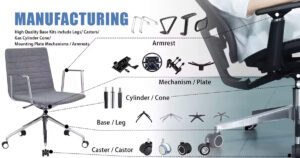
Aluminum vs. Nylon Chair Base Kits: How to Match Material to Application
The Real Cost of the Wrong Material Choice
A nylon chair base kit sourced at 30% below an aluminium equivalent looks like a sound procurement decision on a spreadsheet. In the field, it may not be. A base specified for light residential use installed in a high-traffic commercial environment will accumulate fatigue damage across thousands of load cycles. The failure doesn’t happen on day one. It happens in month fourteen — after the order is closed, after the warranty period is active, and after the brand damage is done.
The reverse error is equally common. Specifying an aluminium chair base kit for a consumer e-commerce product line adds landed cost, increases shipping weight, and reduces price competitiveness — without delivering any structural benefit the application actually requires.
Material selection is an engineering decision with commercial consequences. It deserves a framework, not a default.
Two Materials, Two Physical Profiles — No Value Judgement
Aluminium alloy and high-strength nylon are not in competition. They are different engineering materials with different performance curves. Understanding those curves is what makes a procurement decision defensible.
| Property | Aluminium Alloy (ADC12) | High-Strength Nylon (PA66+GF) |
|---|---|---|
| Tensile Strength | 180–310 MPa | 120–180 MPa |
| Dynamic Fatigue Life | 100,000+ cycles (BIFMA X5.1) | Strong static load; faster dynamic fatigue decay |
| Weight | Higher — typically 2.8–3.2 kg (5-star) | 30–40% lighter — typically 1.6–2.0 kg |
| Moulding Tolerance | ±0.3mm (high-pressure die-casting) | ±0.1mm (precision injection moulding) |
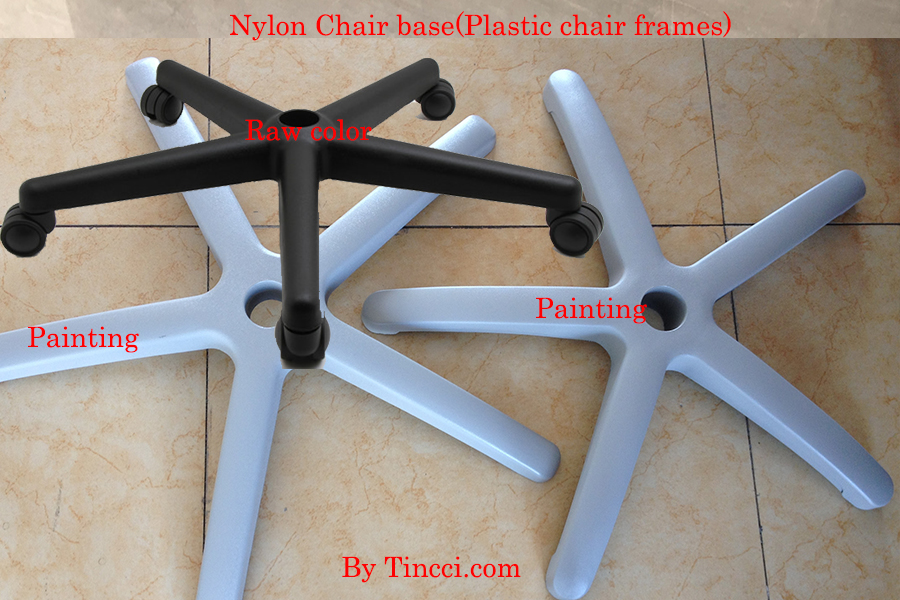
| Surface Finish Options | Chrome / powder coat / brushed / polished | Matte colour / limited spray paint |
| Corrosion Resistance | High (chrome: 200h+ salt spray) | Naturally resistant — no surface treatment required |
| Third-Party Certification | BIFMA X5.1 / EN 1335 / TÜV / SGS | Application-dependent; fewer mandated standards |
| Unit Cost | Higher | Lower |
Neither column is inherently superior. The right column depends on where the chair is going and who is sitting in it.
Four Dimensions for Matching Material to Application
Run your product specification through these four dimensions before finalising your chair base kit sourcing decision. Each dimension will point toward one material — or confirm flexibility. Where all four align, the decision is clear. Where they diverge, the dominant constraint takes priority.
Use Intensity & Load Profile
Market Tier & Channel
Certification Requirements
Product Design Language
Application Decision Matrix: One Table, Four Scenarios
Apply the four dimensions above to your specific product category. The matrix below summarises the recommended chair base kit material by application scenario across five evaluation criteria.
| Criteria | Residential / Home | Light Commercial | Heavy Commercial | Contract / Institutional |
|---|---|---|---|---|
| Structural Demand | Nylon | Either | Aluminium | Aluminium |
| Cost Sensitivity | Nylon | Nylon | Either | Aluminium |
| Certification Required | Not Required | Optional | Recommended | Mandatory |
| Finish Requirement | Nylon | Either | Aluminium | Aluminium |
| Weight Sensitivity | Nylon | Nylon | Either | Aluminium |
Where a cell reads “Either” — both materials can meet the application requirement. The final decision comes down to your landed cost target and brand positioning.
Three Sourcing Mistakes That Cost More Than the Price Difference
The material choice itself is rarely where procurement goes wrong. The mistakes happen at the component integration stage — when base, gas lift, and caster are treated as separate line items instead of a matched system.
Pairing a nylon base with a heavy-duty gas cylinder
A Class 4 gas lift generates higher interface loads at the centre tube than a standard Class 2. Nylon chair base kits engineered for light-duty applications are not designed to absorb that load distribution. The result is accelerated stress at the bore junction — and a failure that looks like a gas lift problem but originates in the base specification.
Pairing a premium aluminium base with low-grade casters
A chair base kit performs to the level of its weakest component. Specifying a certified aluminium base and then attaching casters without EN 12529 compliance creates a structural mismatch. The caster stem-to-socket interface fails before the base does — and the failure is attributed to the entire product, not the single non-conforming component.
Evaluating base unit price without accounting for assembly tolerance
Nylon injection moulding achieves tighter dimensional tolerance (±0.1mm) than aluminium die-casting (±0.3mm). A nylon base sourced from a low-precision mould, however, can produce bore diameter variance that requires line-side correction. At volume, 10 minutes of corrective labour per unit across a 5,000-unit run adds more to total cost than the price difference between material grades. Always request dimensional inspection reports — not just material certifications.
How Tincci Supports Both Material Specifications
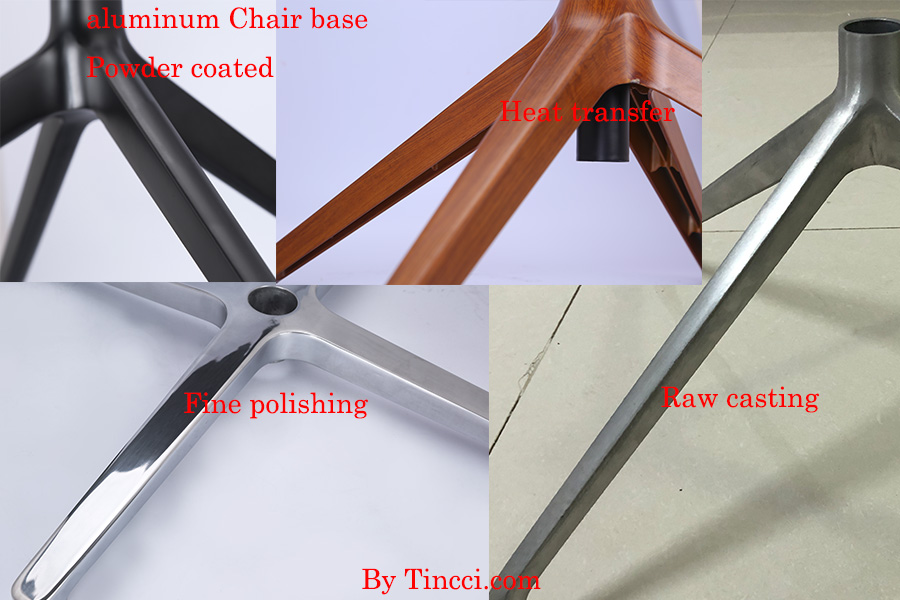
Tincci supplies both aluminium and nylon chair base kits — and we don’t have a preferred answer before we understand your application. Our role at the RFQ stage is to confirm which configuration matches your product category, your target market, and your certification obligations.
Gas cylinder compatibility: Both aluminium and nylon base kits are engineered to the same 28mm centre bore diameter, ensuring direct compatibility with standard Class 2, 3, and 4 gas lifts without fitment adjustment.
Caster socket standard: Both base types use the 11mm standard caster stem socket, compatible with 50mm and 60mm PU or nylon wheels to EN 12529.
Base diameter range: 500mm to 830mm across 4-star and 5-star configurations — available in both materials for custom OEM programmes.
Documentation: Material certification, dimensional inspection reports, and process documentation are standard deliverables for both aluminium and nylon chair base kits — not optional add-ons.
If your product line spans multiple market tiers — a commercial grade and a consumer grade, for example — we can supply matched chair base kits in both materials with consistent interface specifications, so your gas cylinder and caster procurement remains unified across the range.
Not Sure Which Material Fits Your Application?
Send us your product specification — target market, use intensity, certification requirements, and current base dimensions. Our engineering team will confirm the right material and flag any compatibility gaps in your existing component combination.
If you prefer a reference tool first: download our one-page Chair Base Kit Material Selection Matrix — the same framework used in this guide, formatted for internal procurement review.